危机

Reclamation is draining the UIUs, Glen Canyon Dam is in paralysis, Lake Powell is really a lake, the UDS is on track to fall short of their putative Article III(c)&(d) obligations, and Arizona is rattling lawyers. To honor the tradition of magical thinking about the Colorado River, all that makes me hopeful.
“When written in Chinese, the word “crisis” is composed of two characters – one represents danger and one represents opportunity.” Senator John F. Kennedy, 19591
Kennedy was wrong2--it turns out that the two symbols, 危机, mean, roughly, “peril” and “crucial moment” or “hinge point”, which you have to admit is a pretty fair assessment of the current situation on the Colorado.
Rahm Emanuel built on this notion when in 2008 he said:
“You never want a serious crisis to go to waste. And what I mean by that is an opportunity to do things that you think you could not do before.”3
Things that you have always thought that you could not do are exactly the things we must do if we want to develop a durable management scheme for the Colorado River. That opportunity gets me a little bit optimistic. I’m going to close out the summer with this recitation of why I think peril at this hinge moment could lead us to a Grand Bargain, and what I would wish that bargain to look like.
Danger, Danger, Will Robinson!
Both the Upper Division States (UDS) and the Lower Division States (LDS) face serious peril: the UDS from the climate change squeeze, the LDS, and Arizona in particular, from the crap shoot that is adjudication. What motivates the Divisions are not potential gains—these would likely be incremental and temporary —but the realistic prospect of big losses. Those risks of loss arise for different reasons and over different time frames, and those differences may encourage negotiations.
How things might play out—An optimistic view.
Could we wake up some morning to the news that the seven basin states have come to agreement on a sustainable scheme for managing the waters of the Colorado River? No matter how crazy that sounds, I can’t resist thinking that it is a possibility. It’s a possibility because both the Upper Division and the Lower Division have a lot to lose. Success would require both Divisions give up their magical thinking. The UDS must give up its magical overestimation of how much water it could realistically use (a tendency Kuhn calls a “genetic flaw”)4 and its whistling-past-the-graveyard notion that the Compact is some source of certainty in the face the uncertainty of climate change, while the LDS must disabuse itself of the idea that that things will shortly get back into order and that they are safe from consequences of an adjudication of the Compact. Let’s examine the motivating forces, the risks, the perils faced by the two Divisions. These arise from two areas: the likelihood of drier hydrology and the uncertainty of how the terms of the Compact might be adjudicated.
What should motivate the UDS
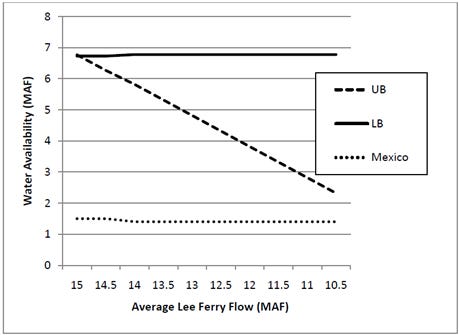
The Upper Basin Climate Change Squeeze, from Kenney et al., 2010. “The figure is based on a host of highly debatable assumptions and simplifications…” Treat it conceptually.
Over the long term the UDS face devastating consequences from further drying due to climate change, but for the short term I believe the UDS can expect business to go on as “usual”. If we assume for the moment that the Compact operates according to the view of the LDS, risk of future drying falls almost entirely on the UDS—what Kenney has termed the “Upper Basin climate change squeeze”.5 Work done for the Colorado River Water Availability Study showed that even current levels of depletion in the UDS are at risk under future climate projections.6 In Colorado, important exports to the Front Range would be curtailed7 and entirely new administrative procedures would have to be developed and put into place.8 In sum, future drying would precipitate enormous economic damage.9 This damage would be compounded if the LDS were able to reduce the protections against impairment of “present perfected rights” by the Compact, set out in Article VIII, either through a challenge to the nature of the protection, or a right-by-right analysis of historical consumptive use of those water rights.10
Over the short term, however, the de facto situation does not seem to expose the UDS to much risk. As Kuhn points out, the Compact is not self-enforcing, contains no enforcement mechanisms, and no agency has the authority to enforce a curtailment of use in the UDS.11 In my view, as I discuss below, the likelihood that the LDS would litigate to enforce the terms of the Compact is extremely low for the precise reason that the first thing that would have to be adjudicated is what those terms mean, and that would open the LDS, primarily Arizona, to very large risks. For now, it seems that the UDS can sit tight—at the whim of Mother Nature.
What Should Motivate the LDS
The consequences to the LDS of the collapse of Lake Powell are immediate because their supply of “bonus water” is gone, and there is little prospect that it will be back for several, perhaps many years, and perhaps forever—this is not a risk, but the reality. Over the 25-year period from 2000 through 2025 annual flow volumes at Lee Ferry have averaged about 8.8 maf. In water year 2026 those flows will be around 6 maf, prospects for substantially higher flows in WY 2027 are unlikely12 and the prospects for any more bonus water are distant.13 Like an addict going cold turkey, breaking a 60-year habit—blithely maintained through this extraordinary drought—the LDS is suffering real pain, particularly the Central Arizona Project14, which is on the sharp end of the shortage spear.
Longer term, and more substantial risks to the LDS arise from uncertainty about just what the terms of the Compact mean. For important context, nothing about the Compact has been litigated, much less adjudicated. In the so-far-only adjudication on the “Big River”, Arizona v. California, the Special Master and the Supreme Court ran away from adjudicating the Compact by finding that to resolve Arizona’s claim all they needed to interpret was the 1928 Boulder Canyon Project Act. Just about every Article in the Compact leaves something unsaid, some important term unclear and something in dispute. Good grief, Article II, a list of definitions, does not provide one for “beneficial consumptive use” which is the basis and measure of the apportionment in the crucial Article III. (What that term means will determine if CAP has water or not.)15
One of these “interpretive risks” arises from the LDS’s consistent exceedance of the 8.5 maf apportionment of Articles III (a) and (b). While there is no mechanism in the compact to enforce these limits on consumptive use, the historical overuse would provide a defense against enforcing the Article III(c) and (d) obligations against the UDS, however those obligations are eventually adjudicated.16 Most of this overuse occurs in Arizona (a smaller amount is due to unaccounted evaporative and transit losses), leaving that state in an especially perilous position if (really, when) the terms of the Compact are adjudicated.
Arizona maintains that its consumptive use of around 5 maf is within its apportionment based on two arguments. In its original claim for relief in Arizona v California, Arizona asserted that the 1 maf of additional beneficial consumptive use apportioned to the LDS in Article III(b) was intended entirely for Arizona’s use from its tributaries (primarily the Gila River system). Arizona further asserted that the negotiators intended that beneficial consumptive use be quantified using “stream depletion theory” (AKA “salvage by use”), a method that gives AZ a “credit” of about 1 maf, for “salvaged” consumptive use, against the conventional measure of beneficial consumptive use from the Gila River system of more than two maf.17 Throw in a few other claims of “salvage” by Arizona and its apportionment would be a bit over 5 maf if it had prevailed on both arguments. Unfortunately for Arizona, the Special Master ducked and did not address any issues involving the Compact, and the Supreme Court agreed. Kuhn and Fleck write that although Arizona failed to get a ruling on its two most important issues, as a practical matter “The river is operated as if Arizona won. Arizona has full use of the Gila River, and there is no accepted accounting for how much water is being consumptively used on the Lower Basin tributaries.”18
Arizona Has Something to Lose
Under those de facto operations, from 2000 through 2024 Arizona consumed an average of about 4.8 maf annually from the Colorado River System, of which about 2.2 maf was from its tributaries.19 Arizona’s exposure is obvious—the Supreme Court’s unwillingness to tackle the Compact leaves both of those critical positions, and the de facto operation of the lower river, un-adjudicated and exposed to legal challenge.20 Arizona can’t afford to lose on either issue, and certainly not on both. Ignoring for a moment evaporation and transit losses, an adjudication of these issues could result in Arizona’s share of mainstem water ranging from a bit less than 1 maf21 to 2.8 maf if it ran the table.22 Any reduction below 2.8 maf will come straight from CAP, which was pumping about 1.6 maf annually until recent shortage declarations. This risk will hang over Arizona indefinitely, either real or not, a sort of Schrödinger’s Decree, until the Compact is adjudicated, something that Arizona must realize will happen when the UDS are squeezed too much.
Then there is climate change. The conventional view has been that the LDS will be the big winner (really, a smaller loser) on a drying river, that as the UDS suffer under the “climate change squeeze” water will continue to flow to the LDS. I confess to taking that view most of the time, but the modern UDS should not be expected to allow itself to get squeezed without a fight, and there are plausible arguments to be made that if climate change has reduced the natural flows of the Colorado River that the UDS have not “caused the flow at Lee Ferry to be depleted”.23 And, despite the reverence that just about everybody gives to the Compact, when throwing spaghetti at the wall the argument of mutual mistake might stick. If all else fails, the UDS might just ignore an LDS “compact call”. As Raphael Moses said, “I would rather be upstream with a shovel than downstream with a decree.”
What Might Happen Real Soon?
One thing I think is very likely is that Arizona, perhaps with the other LDS, will sue the Secretary of Interior complaining that the Secretary did not properly maintain and operate Glen Canyon Dam, with the result that LDS water is “stuck” behind the dam. I think this is likely because cuts to the CAP supply are inflicting pain on Arizona, and Governor Hobbs, who is up for reelection, will be forced to sue someone.24 After all, the state has made a show of lawyering up.
But, a Grand Bargain?
With history as our guide, expecting a real Grand Bargain to emerge seems foolish, but as Samuel Johnson said in 1777, “Depend upon it, Sir, when a man knows he is to be hanged in a fortnight, it concentrates his mind wonderfully.” If the UDS and the LDS are being realistic, all of their minds should now be wonderfully concentrated. However, as I’ve noted above, I think the UDS can sit tight and the LDS is afraid to rock the boat. Maybe it is time for the UDS to rock the boat.
Rocking the Boat.
The UDS has long and widely been viewed as the underdog on the Colorado River. That sort of ignores Mexico, but Americans are nothing if not parochial. I think that view is widely held in the Lower Basin—We just have to wait and the water will come to us, climate change or no climate change. But the asymmetry of the timing of the risks and the exposure to risk from interpretation of the Compact gives the UDS leverage. The UDS might be able to precipitate an immediate crisis for Arizona, with little risk to itself, by forcing examination of Arizona’s “salvage by use” theory through litigation.
The UDS would sue the Secretary of the Interior for over contracting 2.8 maf of mainstem supply to Arizona when Arizona was depleting up to 2.2 maf on the Gila River system, thereby enabling Arizona to exceed a total 3.8 maf apportionment under Articles III(a) and (b) of the Compact. The result is that Lake Mead levels have been unduly and illegally reduced, which in turn caused additional water to be released from Lake Powell under the terms of the 2007 Guidelines, lowering Lake Powell levels, precipitating the collapse of the reservoir and exposing the UDS to claims of non-compliance with the Compact by the LDS.25 One objective would be to force adjudication of the method of calculating beneficial consumptive use under the Compact.
As a nice bonus, this precipitated crisis might split the defenders in the LDS. AZ would face a real threat of losing more than 1 maf of supply, a portion of which would become available to California in the form of surplus or would be owed to Mexico.26
What Should a Grand Bargain Look Like
Kuhn and Fleck wind down Science Be Dammed with this thought:
“[B]eyond the specific numbers to be used in estimating the river’s flow and the resulting development plans, the numbers of LaRue, Stabler, Sibert, and the others suggest the need for a second sort of humility that may be the most important lesson we can learn from this history. It is the need to imbue the institutions for allocating and using the Colorado’s waters with the flexibility to respond when there is less water than we planned.”
That second sort of humility suggests this “Live Within Your Means” Grand Bargain that is based fundamentally on a percentage apportionment of actual natural flow. Many frameworks for Grand Bargains have been proposed for decades, but almost all of them rely on a fixed apportionment, which I view as unsustainable. One of the more reiterated frameworks might be nicknamed “Cap and Waive” under which the UDS agree to a firm, constant cap on consumptive use in return for a waiver (or forbearance agreement) of the Article III(d) obligation on the part of the LDS.27
The obvious question about Live Within Your Means is: how do we know how much water there will be and how can we achieve a split of that water. We do it by looking back, recognizing that we don’t have to get it right every year, that we have storage on the river with which to buffer over- and under-estimates of natural flow and consumptive use, and recognizing that we have the technology and the legal framework to measure consumptive use and to administer a limit to it. This sort of Grand Bargain will be only a little bit more complex than a Cap and Waive Grand Bargain, and it will offer a future that should be far less contentious and more certain than continuing to muddle through the uncertainties and inflexibilities of the Compact. So, how would it work?
Of course making it work will be a lot easier than negotiating that percentage split. So, lets engage in some magical thinking and ignore that difficulty and imagine the Divisions have negotiated the following split: U% of natural flow at Lee Ferry would be apportioned to the UDS, L% to the LDS, and M% to Mexico.28
Those percentage allocations would be applied to past natural flows at Lee Ferry29, say a three-year average. We would be apportioning actual wet water, not an expectation, not a forecast, not a hope. This is the key concept behind Live Within Your Means.
Before considering how to implement the split, let me say that I believe a sustainable Grand Bargain should, to the greatest extent possible, decouple the Upper Basin from what happens within the Lower Basin and vice versa. The difficult part of the apportionment would be administering the U% volume, (how that would be done I describe below), but then the UDS would have no interest in or rights to how remaining water, L% + M%, would be used. What is left over is the business of the LDS, Mexico and the Secretary of the Interior (not to say that would be simple, just easier).
Administering the volumetric grant to the UDS would be done this way: based on the established natural flow supply volume and resulting annual cap on consumptive use in the UDS, the Upper Colorado River Commission would apportion a volume of consumptive use to each of the UDS, according to the percentages laid out in the Upper Colorado River Basin Compact.30 Each state would then administer water within it to consume just its granted volume. Colorado now has just about all the legal and analytical infrastructure it would need to do this; New Mexico, Utah and Wyoming would likely need to implement systems that approximate those of Colorado. New monitoring, modeling and data analysis and management systems would be required for the benefit of all of the UDS.
In order to administer water rights against a limit on the total level of consumptive use the respective State Engineers would need to be able to estimate how much consumptive use would result from each field. Actual consumptive use will depend on weather, crop management and antecedent moisture conditions, so an a priori estimate will have error and the day-to-day administration of water rights will introduce other errors.
An ex post estimate of actual consumptive use, using modern technology and techniques will be required to “true up” the real-time estimates of consumptive use for a field, for a state and for the UDS as a whole. An all-of-the-above methodology would be used, exploiting remote sensing combined with modern, weather-based methods of estimating actual CU and emerging technologies, including machine learning.31 An ongoing calibration process would improve forecasts, real-time estimates, and ex post estimates of consumptive use to progressively improve estimation and administrative processes.
Any overshoot or undershoot of the apportioned consumptive use would be debited or credited to accounts for the next water year.32 Because the UDS states do not have large reservoirs to regulate variable natural flows they will not be able to smooth the weather-driven variability of consumptive use from one year to the next. This could be addressed by giving the UDS the ability to store unused CU in Lake Mead, something like the current Intentionally Created Surplus system.
An advantage of this Grand Bargain to the UDS, which are all prior appropriation states, is that it sets an annual limit of total consumptive use, against which it is possible to administer water rights without causing undue harm to seniors. Using conventional administrative practices against a cumulative obligation will inevitably cause undue harm to senior water rights.33
Just to be very clear, this Live Within Your Means Grand Bargain could be seen as fine-tuning Cap and Waive to insure sustainability in the face of likely further drying. In essence, Live Within Your Means differs only from Cap and Waive in that the cap on UDS consumptive use is set every year based on some measure of actual water supply. A fixed “maximum cap” could also be incorporated to provide some hope of an upside to the LDS. All of this would be negotiated. Further, bear in mind that all of the year-in, year-out monitoring and accounting I have outlined above for the Upper Basin would also be necessary for a Cap and Waive Grand Bargain, so the additional complexity of Live Within Your Means arises only from the process of monitoring natural water supply and setting the annual “cap” based on the agreed-to percentage apportionment.
Water not consumed by the UDS would flow, as it does now, to the LDS to be stored or used as it sees fit. Administering the allocation of those supplies within the Lower Division would be very much as it is today--mainstem water is released (or pumped) from Lake Mead according to contracts or the Mexican Treaty. While there will certainly be technical issues and disputes that must be resolved, business on the Lower River could sort of proceed as usual.
My personal preference
With this sort of Grand Bargain in place, with the Compact and its Article III(c) and (d) rendered obsolete (perhaps by waiver or forbearance), there would be no need for Lake Powell as a patch for that fundamental error in the Compact, the far-too-short 10-year obligation window, so Lake Powell could finally live up to its name and be operated as run-of-river. I would go further, though. It is well appreciated by now that Lake Powell submerged the inarguably beautiful Glen Canyon. What’s not appreciated as broadly is the profound change that Glen Canyon Dam wrought on the Grand Canyon by cutting off its supply of sediment and regulating its hydrograph34. I’d like to see both of these destructions reversed, and the way to make that happen would be to open a river-level bypass of Glen Canyon Dam. I don’t think this would be as hard, or as costly, as people make it out to be. This would restore two canyons.35
A Personal Note
First, I would like to thank Robert Wigington for his very thorough readings and his contribution of ideas and perspective. I appreciate his help and his good humor, as well as his company on bicycle rides. As for me, I’m going to spend the rest of the summer, and the early fall outdoors, on a long bicycle tour in Canada, in the Boundary Waters and in Glen Canyon exploring the emerging canyons there. Oh, yeah, and doing a lot of deferred domestic chores and probably some politics (ugh on both counts). I’ll be watching what happens on the Colorado River, without too much pride invested in whether anything I’ve said here comes true.
Remarks of Senator John F. Kennedy, Convocation of the United Negro College Fund, Indianapolis, Indiana, April 12, 1959, https://www.jfklibrary.org/archives/other-resources/john-f-kennedy-speeches/indianapolis-in-19590412
危 (wēi) does mean “danger” or “peril”, but the most supportive interpretation of 机 (jī) is “crucial moment” or “hinge point”. Benjamin Zimmer, http://itre.cis.upenn.edu/%7emyl/languagelog/archives/004343.html. Kennedy is not alone. Others who have repeated the trope include John Foster Dulles, Condoleezza Rice, Al Gore (a repeat offender), President Obama and Lisa Simpson: “Look on the bright side, Dad. Did you know that the Chinese use the same word for ‘crisis’ as they do for ‘opportunity’?” “Simpsons” episode “Fear of Flying”, 1994.
The thought has been attributed without evidence to Niccolò Machiavelli and Winston Churchill.
The Upper Basin, Lower Basin, and Mexico: Coexisting on the Post-2026 Colorado River, 2019. Eric Kuhn & John Fleck.
Douglas Kenney et al., Rethinking the Future of the Colorado River 16 (Nat. Resources Law Ctr. 2010).
CRWAS Phase I Task 8.6 Summarize Compact Effects These results were framed in terms of “water available for future development”, which was reported as zero in some cases. The underlying analyses showed those cases to require cutbacks to current uses. https://cdss.colorado.gov/resources/colorado-river-water-availability-study
Risk Management Strategies for The Upper Colorado River Basin, Eric Kuhn, 2012.
An additional difficulty for the UDS, at least for Colorado, is that administering any curtailment resulting from a Lee Ferry flow deficit (however adjudicated) or any attempt to administer water rights to avoid such a deficit, will inevitably be challenged as causing undue harm to relatively senior water rights. New and complicated administrative practices would be required. Reservoir Memory Complicates Water Management in the Upper Colorado River Basin Harding, 2024; Kuhn, Risk Management. 7
Kuhn, Risk Management. 7
Kuhn & Fleck, Coexisting. 4
The Risks and Potential Impacts of a Colorado River Compact Curtailment on Colorado River In-Basin and Transmountain Water Rights Within Colorado. Kuhn 2024.The DOI has changed the operation of the Upper Initial Units of the Colorado River Storage Project (UIUs, excepting the Navajo Unit) this year, and some have suggested that the DOI could fully or partially shut down federally owned projects such as the Colorado Big Thompson Project.Of course, that action would immediately trigger litigation.
Reclamation’s June 24-Month Study, Most Probable case projects 7 maf of releases in water year 2027 but doing so would force Lake Powell below minimum power threshold. Ask again in, say, March.
If inflows increase, and Lake Powell storage recovers, annual flow volumes at Lee Ferry could return to 8.25 maf, but I would expect the UDS to raise Section 602(a) of the Colorado River Basin Project Act (P.L. 90-537) and object to releases above that level until Lake Powell and the UIUs are approaching full. This could take decades.
Arizona failed the marshmallow test in 1968 when they agreed that CAP would take the first shortages in the Lower Division as the quid pro quo for federal authorization and financing for the project.
Many talented and thoughtful people, better qualified for the task than I, have cataloged the vagaries in and consequent disputes about the Compact. We can start with why the definition of “beneficial consumptive use” is so important with Kuhn and Fleck, Science Be Dammed: How Ignoring Inconvenient Science Drained the Colorado River, 2019, p132. Featured in Last Week Tonight with John Oliver; see also Kuhn & Fleck, Coexisting. 4; Sources of Controversy in the Law of the Colorado River: An Upper Basin View. MacDonnell, 2022.
Kuhn & Fleck, Coexisting. 4, p42; MacDonnell, Controversies. 15.
Kuhn and Fleck provide a thorough discussion of both issues in Science Be Dammed, p132 and in Coexisting. 4, p23.
Kuhn & Fleck, Science Be Dammed, p224
Average (2000-2024). From Reclamation’s 1971-2024 consumptive Uses and Losses Report. This does not include the net amount of water Arizona has stored in and recovered from its underground storage facility.
Meyers, 1966: “As heretofore indicated, the Special Master in Arizona v. California construed the compact in dictum as adopting the formula ‘diversions less return flows’."; MacDonnell, Controversies. 15. “…more than 60 years later we are still without any interstate agreement about tributary uses—a fact that continues to be a source of controversy between the basins as well as among the states of the Lower Basin.” [emphasis added]
This amount would result if Arizona lost its claim to exclusive use of the 1maf apportioned to the Lower Division in Article III(b) and, instead, the Article III(b) water is apportioned in proportion to mainstem apportionments, and also lost its claim that beneficial consumptive use is quantified by stream depletion theory, AKA salvage by use.
Bearing some share of the evaporation from lower mainstem reservoirs will reduce these amounts further.
Kuhn, Risks. 12; MacDonnell, Controversies. 15
The Colorado River States are Deadlocked and the River is Crashing. Will a ‘Grand Bargain’ Finally Get its Day?, Matt Jenkins, 2026. Perhaps the Upper Division States might join this litigation, since the “stuck” water has precipitated the LDS claim of a deficit at Lee Ferry.
One rebuttal is that when the U.S. Supreme Court ducked in Arizona v. California and endorsed 2.8 maf of mainstem contracts for Arizona, the court’s decision by implication was that those contracts would not be limited by Arizona’s depletion of the Gila River system. An alternative litigation strategy for the UDS is to sue the Secretary of the Interior as the operator of the federal reservoirs under Section 602(a) of the 1968 Colorado River Basin Project Act to determine if Arizona’s depletion of the Gila River has enabled Arizona to use more than its compact apportionment, with the result of much the same harmful federal reservoir operations.
The UDS would not be risk-free in Compact litigation. One issue where I can see things could be made worse for the Upper Basin is if the court should impose transit losses on the UDS portion of the Mexico treaty obligation. Surely by now the UDS have evaluated the plausible range of transit losses.
Kuhn & Fleck 2019, 4, review the convolution of consumptive use accounting and maneuvering between the UDS and LDS, reference the early (2005) proposal for a grand bargain under which the UDS would cap their consumptive use at close to current levels in exchange for the LDS waiving all Article III obligations against the LDS, and conclude by elaborating on that proposal and offering another less radical one, they say, that mostly downsizes the UDS’ Article III obligations but still maintains them as fixed obligations, while the only thing that is fixed under the cap and waive bargain is the total consumptive use by UDS, mostly in terms of new exports. Wheeler, et al. 2022 quantitatively examines the cap and waive bargain in Alternative Management Paradigms for the Future of the Colorado and Green Rivers https://qcnr.usu.edu/coloradoriver/files/news/white-paper-6.pdf. Jenkins 2026, 22, brings cap and waive back into immediate view.
I’m going to engage in more magical thinking, perhaps very magical. I don’t have a proposal for how this would work, but thinking conceptually, perhaps the Grand Bargain could somehow include E% apportioned for environmental uses.
The agreement could also be based on the natural flow supply at the border, i.e. in the entire Colorado River System defined by the Compact, but this would add considerable complexity, and as I suggest below, it is my objective to decouple the UDS and the LDS as much as possible.
Colorado, 51.75%; New Mexico, 11.25%, Utah, 23%, Wyoming, 14%.
One interesting technology is atmometers which are inexpensive devices that are a physical model of actual consumptive use. These are inexpensive enough to be widely deployed at the field level.
These adjustments could also be applied over more than one year to reduce year-to-year swings of allowable consumptive use.
Harding, Reservoir Memory. 8; Kuhn, Risk Management. 7. Trying to limit Colorado’s consumptive use by, say, placing intra-state “calls” at the state line will inevitably harm seniors who, once they figure this out, will object and probably litigate the issue. This is an unavoidable problem that can only be mitigated by complicated post hoc accounting and settlement.
“The most significant environment-modifying event in the recent history of Grand Canyon was the construction of Glen Canyon Dam and its associated changes in flow regimes, which began in 1963.”, Riparian Vegetation in Grand Canyon: An Overview; Influence of Dam Operations on Geomorphology and Sediment in the Colorado River corridor, Grand Canyon National Park, Arizona; The State of the Colorado River Ecosystem in Grand Canyon; Johnson, R.R., and Carothers, S.W., 1987, External threats—the dilemma of resource management on the Colorado River in Grand Canyon National Park, USA; The State of the Colorado River Ecosystem in Grand Canyon, USGS.
Doing this would eliminate hydropower production at GCD, but in the long term, as solar, wind and battery storage rapidly mature that will be replaced. (It will be one of the great ironies of modern life that the technology that might actually produce “energy too cheap to meter” is that hippie-dippie solar power stuff.) A benefit is elimination of evaporation from Lake Powell, which averages about 0.5 maf. That benefit could be shared by the two Divisions. Total storage on the River would be reduced roughly in half, so a return of a sustained wet period would lead to spills from Lake Mead. But, given the “live within your means” basis for the Grand Bargain, Lake Mead would be buffering only about three years of variability, plus a safety factor, so it could be run at much lower volumes, which would reduce spills. And, those spills would serve to improve environmental conditions in the Colorado River Delta, which was substantially denatured by the mainstem dams.