
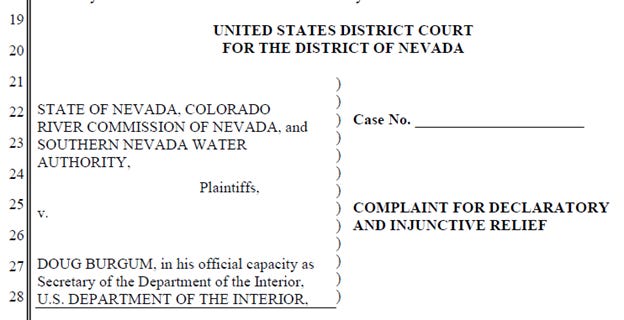
The Record of Decision (ROD; really RODs) for post-2026 operations on the Colorado River dropped on a Friday and on the following Monday Nevada filed a complaint in Federal District Court against the Secretary of the Interior. I thought Arizona would go first, but Nevada beat them to court.
Nevada, as we should expect, rousted out the usual suspects allegedly responsible for the failure of the river system and the failure of the negotiations, namely the Upper Division States, which in the view of the Lower Division States have been unwilling to agree to “share the burden” with mandatory cuts in water use, and have been stubbornly unreasonable in that unwillingness. More substantively Nevada reiterated the LDS complaint that Interior and Reclamation have not even offered an interpretation of the Colorado River Compact, much less put forward some procedures to enforce it.
“…Reclamation’s failure to interpret and disclose application of the Law of the River, particularly the implications of a likely Compact Call, falls short of the minimum requirements of NEPA and leaves stakeholders to speculate regarding Reclamation’s intentions regarding future Colorado River operations during low-flow conditions.” (Complaint at 13)
This element of the complaint was the focus of Nevada’s press release, comments from state and water officials, and the press that I have seen. Some people seemed relieved that Nevada did not go for the “Nuclear Option”, an original jurisdiction complaint against the upper division states before the U. S. Supreme Court. The histrionics about stubborn, freeloading upper division states, Compact Calls and how Interior should interpret and enforce Colorado River Compact are not serious argument. For Pete’s sake, it is not Reclamation’s job to interpret the compact (they’ve avoided anything close to that for a century) and Interior has no authority to enforce the Compact. If you want the Compact to be interpreted authoritatively, drop the Nuclear Option1.
No, the big story, and I have not seen even a sideways mention of this in the press or by anyone who is not an Arizona official, is that Nevada is throwing the Central Arizona project under the bus.
Nevada’s most substantive complaint is the argument that the RODs contemplate cutting back water use in Nevada unfairly and illegally. They point out that the state could be subject to an involuntary shortage of 213,556 acre-feet2, an apocalyptic 71% of the state’s apportioned 300,000 af. This is a possibility, but only a possibility so their quantitative claim does not seem ripe. But, to my eye, on the Law of the River, on the principles, they do have a point.
First I’ve got to drift into the weeds a bit to make one thing clear. Two RODs dropped Friday, one titled “Decision Framework for Colorado River Guidelines: Coordinated Operations of Lake Powell and Lake Mead (2027-2036)” and another titled “Operating Guidelines…for Coordinated Operations of Lake Powell and Lake Mead Operating Years 2027 and 2028”. It’s in the Operating Guidelines where the rubber immediately meets the road—they will govern operations for the next two water years. The Decision Framework ROD establishes “operational sideboards” for the operational guidelines that will be issued every two years through 2036. The 2027-2028 Operating Guidelines stand apart because they incorporate a proposal put forward by the LDS, but future guidelines will be issued (as RODs) within the constraints set by the Decision Framework. As such, the Decision Framework is a maximalist document and that is where Nevada’s potential apocalyptic cutback can be found.
With respect to cutbacks to the LDS, the 2027-2028 Operating Guidelines adopt the LDS proposal from May 1, 2026 for a reduction of 1.5 maf in water released from Lake Mead, with 1.25 maf of that amount coming from the LDS states and the remaining 0.25 maf coming from Mexico. To attain that level of reduction the Operating Guidelines (and the LDS proposal) imposes a cutback of 50,000 af on Nevada. Nevada can’t really complain about that—it was their idea. All the Guidelines say about what happens if 1.5 maf is not enough to keep Lake Mead above 1,010 ft is that the Secretary will consult with the LDS and tribes (and “other affected parties”, presumably Mexico) about “potential actions”. However, Chapter 2 of the Final EIS, on which the RODs are based lays out additional cutbacks (in Table 2-3) to get to a reduction of 3.6 maf (Nevada’s share would be199,000 af). The number Nevada cites in their complaint comes from Table 2-4 laying out the “operational sideboards” for cutbacks from 2029-2060. (I’m not sure where 2060 came from.)
The FEIS says that U.S. cutbacks above the agreed-to 1.25 maf for 2027 and 2028 and all U.S. cutbacks from 2029 through 2060 will be “distributed using the priority system”. This is where Nevada’s complaint focuses and from what I see I think they are right. Let’s review how that “priority system” developed.
The Special Master in Arizona v. California, Simon Rifkind, sent a recommended decree to the U.S. Supreme Court on December 5, 1960. Rifkind suggested that in the event that “insufficient mainstream water is available for release [from Lake Mead]…to satisfy annual consumptive use of 7,500,000 acre-feet [in the LDS]” then the available consumptive use would be apportioned pro rata, according to the shares set out by Congress in the Boulder Canyon Project Act. This makes perfect sense to me, and apparently did to the Special Master, but the Supreme Court tossed that idea and essentially said, in the event of a shortage, the Secretary of the Interior, after consulting with the states and contractors can divvy the water up however he or she wishes.
As soon as the decision in AZ v. CA was handed down (literally the next day3) Arizona took the CAP ball and ran with it…headlong into the immovable object that was California. Arizona was finally able to get CAP authorized by Congress in Section 301(a) of the 1968 Colorado River Basin Project Act (CRBPA), but to get California (and probably Nevada, as well) to step aside Arizona had to agree that CAP would take the lowest priority on the lower river, and that agreement became part of the Law of the River in Section 301(b) of the 1968 Act.
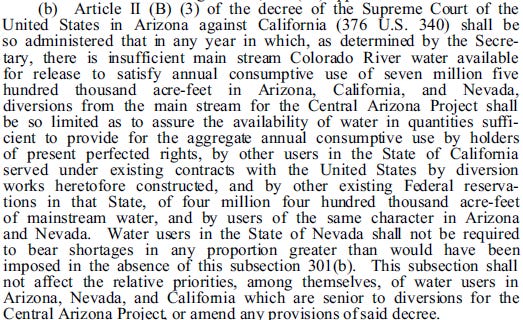
Maybe Nevada and I are missing something, but this seems pretty straightforward: CAP would be cut back to nothing before any cutback would be required of water use in California or Nevada. But, that’s evidently not the “priority system” that the Secretary is applying. Table 2-4 of the FEIS sets out the cutback amounts in two steps, up to 1.814 maf4 and from 1.815 maf up to 3.6 maf. (Note that the percentages in Tables 2-3 and 2-4 represent an entity’s share of the total cutback in that “tier’. I provide the tables with additional calculations in the Appendix).
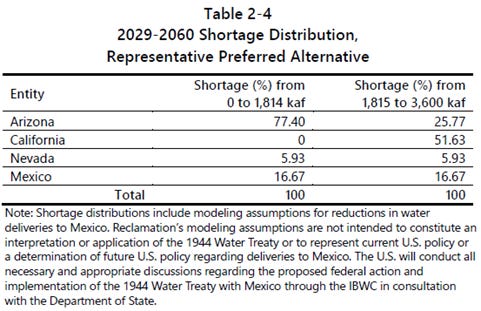
Nevada’s primary argument is that Section 301(b) seems to require that CAP be cut back to zero before Nevada takes any shortage, and I read the section the same way, though I won’t pretend to understand all the nuances of the contracts and decrees in the Lower Basin or the ways that Interior could stretch the Secretarial discretion provided by the Supreme Court.
I have read a few comments to the effect that this litigation could freeze everything. That’s possible, if a judge were to enjoin Interior and Reclamation, and Nevada did ask for an injunction against implementation of the ROD and the Operating Guidelines. I would expect the court to duck this one on one or more technical grounds, but, as we’ve seen recently, on any given day, judges do unexpected things and if Nevada’s injunctive relief were granted I think Reclamation would fall back to the 1970 Criteria for Coordinated Long-range Operation of Colorado River Reservoirs. Section III(3)(c) of those Criteria sets out provisions for dealing with shortage, references the Secretary’s discretion granted in AZ v. CA and then says “…consumptive uses from the mainstream shall be restricted to the extent determined by the Secretary to be required by Section 301 (b) of Public Law 90-537 [the CRBPA].” It seems that would be a win for Nevada. But, in Becky Mitchell’s words, this would not create any water, and mother nature will enforce cutbacks on the LDS no matter what.
No matter what happens, this complaint has put a wedge into the crack in the unity of the Lower Division States. Arizona can’t be happy about this turn of events but so far the State, water agencies and interests there have been circumspect about the Nevada lawsuit. An ADWR spokesperson said on the 24th that they are “…evaluating Nevada’s complaint and are working on a proper course of action moving forward.” Tom Buschatzke went a bit further, saying that the complaint “…certainly adds a significant additional level of uncertainty to all of the outcomes facing us.” Buschatzke then again flogged the boilerplate saying the adopted policy “includes fundamental legal flaws including a failure to comply with the Colorado River Compact and other key elements of the Law of the River,” including the decision not to impose mandatory cuts on the Upper Basin, something that the LDS are united about. He seems to hope that the Compact Call Cavalry will ride to the rescue of the Lower Division (really CAP) but it ain’t going to happen. I will explain why I believe that in my next article.
Appendix

Nevada may not have a lot to lose in the Nuclear Litigation, but Arizona does, as I laid out in a previous article.
My training means that I can’t resist noting that this number is expressed to six significant figures, implying that the expected volume is known down to the acre-foot. At least they didn’t carry the percentage cutback out to 71.1853. See Proofiness: How You’re Being Fooled by the Numbers, by Charles Seife
Nathanson, Updating the Hoover Dam Documents, 1978, at 195.
I haven’t read the FEIS carefully so I can’t tell you why that break at precisely 1.814 maf is there.